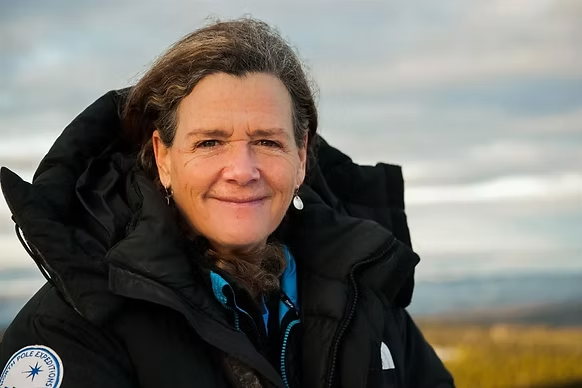

ANCHORAGE, Alaska — Elizabeth Arnold, the award-winning journalist whose distinguished career with National Public Radio took listeners from presidential campaign buses to the Arctic ice cap, died June 18 at her home in Anchorage following complications from endometrial cancer. She was 66.
Known for her relentless curiosity, sharp reporting instincts and adventurous spirit, Arnold spent more than two decades covering some of the most consequential political and environmental stories of her era. Her reporting spanned Congress, presidential elections, climate change and remote corners of the globe, earning national recognition and the respect of colleagues across the journalism industry.
Arnold’s career reflected an uncommon combination of political expertise and environmental storytelling. As an NPR correspondent, she covered the 1992 presidential campaign of Bill Clinton and the 1996 campaign of Bob Dole, becoming one of the notable women journalists known as the “girls on the bus” who chronicled modern American politics from the campaign trail.
At the same time, she built a reputation for immersive environmental reporting, traveling extensively to document climate and conservation issues. Her assignments took her to the peaks of Tibet, the salmon rivers of Russia’s Kamchatka Peninsula, snow leopard habitats in Mongolia and scientific expeditions in the Arctic, including two journeys to the North Pole.
“Elizabeth was one of NPR’s most respected and talented journalists,” said Jay Kernis, founding producer of NPR’s Morning Edition. “Her political and environmental reporting helped listeners understand the world in deeper ways. She had a remarkable ability to bring distant places to life.”
Born in Northampton, Massachusetts, Arnold graduated from Colgate University in 1982 and launched her journalism career in rural Alaska. She began at the Tundra Drums newspaper in Bethel, where she often joked that her duties included typesetting and emptying honey buckets before reporting became her primary responsibility.
Her path to national journalism started at KTOO public radio in Juneau, where she worked as a local reporter before being selected for a temporary assignment at NPR headquarters in Washington in 1989. On the day she arrived, the Exxon Valdez oil tanker struck Bligh Reef, triggering one of the largest environmental disasters in U.S. history.
Though NPR initially relied on Arnold’s Alaska expertise from Washington rather than sending her into the field, the assignment proved career-defining. She quickly became a key reporter covering federal responses to the spill, congressional investigations and White House actions, eventually earning a permanent position with the network.
Over the years, Arnold received numerous honors, including the Dirksen Award for Distinguished Reporting on Congress and a prestigious Alfred I. duPont-Columbia Award as part of NPR’s political coverage team. In 2018, she was selected as a fellow at Harvard University’s Shorenstein Center on Media, Politics and Public Policy.
After leaving full-time reporting, Arnold returned to Alaska and joined the University of Alaska Anchorage in 2009. Over the next 17 years, she became one of the state’s most influential journalism educators, teaching courses in radio reporting, podcasting, media ethics and natural resource reporting while also serving as department chair.
Her academic work focused heavily on climate communication. She gained international attention for her research challenging media portrayals of climate-affected communities, arguing that overly pessimistic narratives often discouraged public engagement rather than inspiring action.
Beyond the classroom, Arnold played a major role in strengthening local journalism throughout Alaska. She helped establish the Alaska News Coalition and the Alaska Center for Excellence in Journalism and co-founded the Reporter Exchange Program, which provides newsroom support across the state.
Former students and colleagues credit her mentorship with launching countless journalism careers.
“If you turn on a radio station, watch local television or read a newspaper in Alaska, chances are you’ll find someone whose career was shaped by Betsy,” said Lisa Busch, a longtime colleague and fellow journalism advocate.
Away from journalism, Arnold embraced Alaska’s outdoors with the same enthusiasm she brought to reporting. She was an avid runner, fisherwoman and Harley-Davidson rider whose adventurous nature became part of her identity.
She is survived by her husband, Steve Buckley of Anchorage; her son, Jack Consenstein of San Francisco; her brother, Peter Arnold of New York; and former husband Danny Consenstein of Anchorage.
Her family has requested that memorial donations be made to the Alaska News Coalition, an organization she helped build to support local journalism across the state.
Arnold’s death marks the loss of a journalist whose career bridged politics, science and public service, leaving an enduring impact on both national journalism and Alaska’s next generation of reporters.